

The Museum Ship Pommern
“Grain Race” winner in 1930 & 1937!
“If you’re in Åland, a visit to the Pommern is a must. To experience it and walk around the well-signposted and well-documented ship with your own senses awakens both imagination and curiosity.”
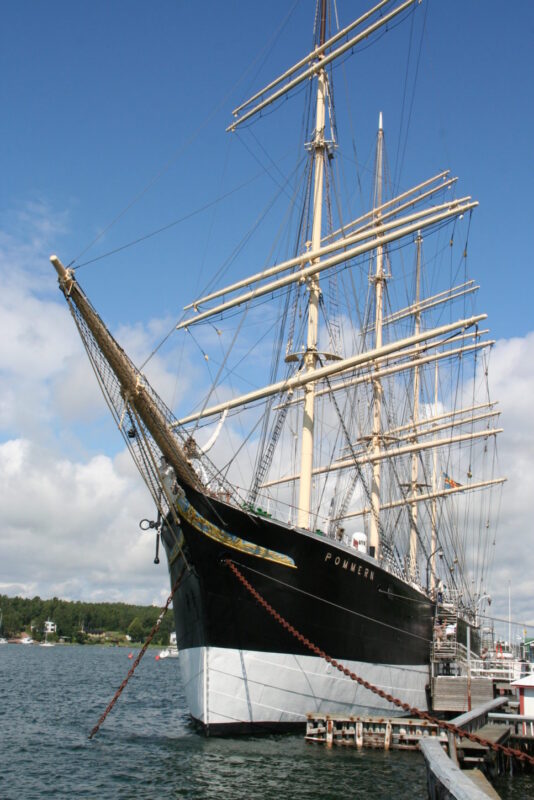
Below Badhusparken, in Mariehamn’s western harbour, lies the barque Pommern—one of the few sailing ships still remaining in the world. She rests quietly there, reminding us of Mariehamn’s past as the home port of the great sailing fleets once owned by shipowners in Åland.
What makes the Pommern unique is that she is still preserved in her original condition as a cargo vessel. Many of her sister ships still exist, but all have been rebuilt to a greater or lesser extent.
Pommern was built in 1903 in steel and rigged as a four-masted barque. She was built in Glasgow, commissioned by the shipping company B. Wencke & Söhne in Hamburg.
She is 95 metres long and 13 metres wide. The mainmast is 50 metres high and her draught is 7.5 metres. With all sails set, the total sail area amounts to 3,240 square metres.
The crew on board generally consisted of 26 people, but voyages were also made with only 20 on board—especially from Australia, as one or two would be seized by a taste for adventure and disappear ashore.
Pommern was sold in 1906 and had two different owners during the years 1906–1923. After the end of the First World War, Greece received Pommern as war reparations. The Åland shipowner Gustaf Erikson learned that she was for sale in the Dutch town of Delfzijl and sent a ship inspector. The purchase was carried out almost immediately, and Gustaf Erikson bought Pommern from the Greek state for £3,900. Even at that time, it was quite a lot of money.
Pommern then sailed mostly on the route between England and Australia. With a total cargo capacity of 4,050 tons, she could on average carry 49,000 sacks of wheat.
The wheat clippers of that era competed unofficially with each other. The record in the wheat trade, or “The Grain Race,” was set in 1933 by the ship “Parma” with 83 days. Pommern’s fastest voyage was 94 days in 1936.
In 1939, Pommern made her final voyage from Hull in England to Mariehamn. Since then, she has remained in her home port, with the exception of the second half of 1944 when she was towed to Stockholm to serve briefly as a grain warehouse.
In 1947, Gustaf Erikson passed away and Pommern was then put up for sale. Unfortunately, she required extensive repairs and, as the age of sail was drawing to a close, she remained unsold. In 1952/1953, Edgar Erikson, Gustaf’s son, and his sister Eva Hohental decided to donate the ship to the City of Mariehamn.
If you’re in Åland, a visit to the Pommern is a must. To experience it and walk around the well-signposted and well-documented ship with your own senses awakens both imagination and curiosity. Today, you can download an app to your phone and get a guided tour of the ship.
There are countless photographs on display, showing images from the bygone era when the ship crossed the great oceans amid lashing winds and towering waves… Together with our guide, we drift away for a while and enjoy the wings of history…
Welcome to the museum ship Pommern!
More information about Pommern can be found here:
An article about the Line Crossing »
Photo & Text: Björn Pettersson
Facts from: See Åland and Pommern’s website
Facts about Pommern
- Launched: January 13, 1903
- Length: 89.18 meters at the waterline, 94.67 meters overall
- Beam: 13.21 meters
- Draft: 6.2 meters
- Sail area: 3240 m²
- Speed: max 16 knots
- Displacement: 3950 dwt
- Radio signal: OHQW


